

Mastering the starting
Moving from theory to practice & beyond

Welcome to Supercharged Learning HQ. The place where you can get practical insights to learn new subjects and acquire skills fast without outdated learning methods or the overwhelm of information overload
Hello friend, welcome back!
It’s now the beginning of March.
Time to get back into action cause we have work to do. Speaking of action, today I’m sharing with you a framework for getting started when tackling a big project or challenge.
Let’s get it.

Main quest 🛡
Let’s be real.
In an ideal world we wouldn’t wait for a “perfect plan”. We would get clear on where we anted to go, and start taking the steps to get there.
But in the real world, we find several different reasons as to why we can’t get started.
Either because we don’t even know what’s the goal we’re after, don’t know how to get started, think that we need more preparation, think it’s “not for us”, or anything else from the myriad of reasons that can come up.
As an over-thinker and over-planner, I can tell you that none of the extremes work. That is, waiting to have everything figured out to start taking action OR recklessly starting and seeing where the actions take you.
The sweet spot is somewhere between proper planning and directed execution.
And instead of making a whole diagnostic of the problem. Why we default to overplanning or no planning at all, why we often lack the confidence to start something, or why the fear of the unknown beat us in the search for a better place.
I’m going to give you my framework for overcoming barriers and start getting results.
1. Shrink the Bet
2. Borrow the Proof
3. Script the Start
Optional 4th step
Starting with…
Step 1: Shrink the Bet
Lower the stakes until starting feels trivial
Back when I was a full time web dev, I got involved in a volunteering initiative to help high-school seniors get their first role in tech.
Along with the other participants of the program, we would have a group of students and would give them lessons on different subjects.
In my case, I wouldn’t only give them the lessons. I would also bring in concepts to help shift their mental model. One of those was the concept of reframing.
In this context, the reframing was not thinking about the “get a tech role” as the goal.
That would feel like an impossible for someone in that stage.
The goal instead could be “attend the 4 sessions in the cycle“. Or even something smaller like separating the time to make it to one call.
This step you might have known from the theory of habit building.
Starting is often the hardest part. So making it so easy that I’d feel dumb not to start, it’s the best way to go.
Step 2: Borrow the Proof
Find evidence it’s possible for someone like you
One of the most common excuses I’ve heard or seen over the years (that I was also guilty of) is the notion of “that worked for X person, but it wouldn’t work for me“.
“It’s easy for them because they’re from a 1st world country, have rich parents, know important people, are 6ft+ tall, aren’t skinny, have good genes”
You name it, the list can go on and on.
The thing is these excuses exist cause we don’t have a proper frame of reference.
People from low/middle class that want to launch their own startup see it as a daunting goal, and wrongly think that is for people with better socioeconomic status, much smarter than them, or with better connections.
Then there’s someone who is a successful entrepreneur who beat the odds to get there. And the excuse shifts to a different area.
With the internet and social media, it’s not much easier to break down those excuses and show peple that they can achieve that particular goal, even if they:
Aren’t rich or have rich parents.
Don’t have a full college degree.
Don’t have a rolodex of important people.
Aren’t built like an athlete.
Come from a poor background.
Don’t speak a language or have thick accent.
And so on, and so forth.
With seemingly true hypothesis, you only need one counterexample to reveal for what they are: false narratives holding people back.
Step 3: Script the Start
Define only the next 2-3 actions
Here’s an interesting point.
There are people who only focus on the start. There are others who say the end is more important.
But it’s not an “either or” situation, it’s more a “both” one.
Let me explain.
Both sides are missing an important part. We already talked how most people approach learning in a wrong way.
What you want to do in this step is to pay attention both at the end goal AND the first steps to get there.
Only define what are the immediate 2-3 steps you need to get started. Everything else is noise and can be figured out later. What’s important is to get started and build momentum.
So you set your big, bold, audacious, goals but you don’t stop there, you also map out the initial steps.
You need both long-term vision and short-term execution.
Balancing those two is more an art form than a science.
But getting it right will save you so much time, effort, headaches, and confusion.
Step 4: Forcing Functions
If you want an extra “kick in the butt”
Now, there are some types of people that won’t need this step. They can take the previous steps and already be well in their way to cut through the noise and start making strides in the path to goal completion.
But for the rest of us, who might need a bit more help, or a little push, this step comes into place.
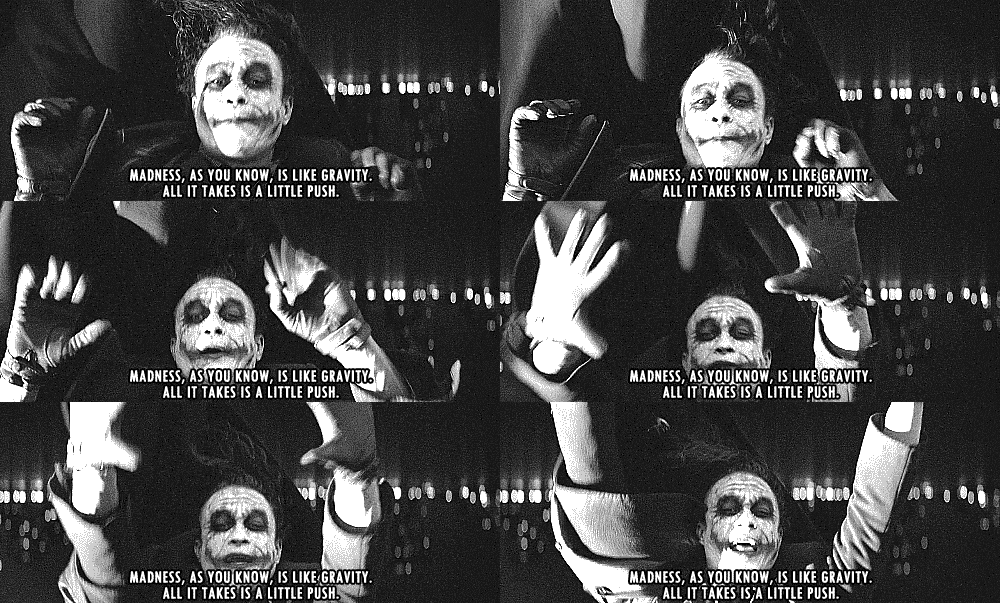
A forcing function makes the starting much harder than staying idle.
It can be any sort of device like:
Accoutnability partner
Public post on socials
A bet with a friend
Progress reporting to a group
What Tim Ferriss calls an “anticharity”.
And so on.
The point is that the discomfort you feel by any of the above options, will force you to move your ass into action.
It’s like if you’re too comfortable in your couch to go out and exercise. Then someone comes in and lights a fire on one of the sides.
Eventually, you’ll have no choice to stand up and move out.
How it works in practice
Now all of this might sound good. You can read it and nod along or be like “yeah, that makes sense”.
But let’s make it concrete.
Here’s an example of how someone can use this framework to go from “stuck” to making progress (adapted from the situation of my older brother’s friend).
In the current state:
Has expertise from his day job in marketing creating and running campaigns.
It’s bored of the job and wants to do pursue other options and activities.
It’s in a comfortable position and doesn’t want to risk that by quitting just yet.
Has been talking with his girlfriend about starting a coffee brand, a YouTube channel, some paid offerings.
It’s frozen with aaction thinking "I don't have an audience," "Who would pay me?", "What if I fail publicly?"
Has been “thinking about it” for a good 6 months and knows that he needs to get started with something.
Now, when applying this framework, it could look something like:
Step 1: Test if 3 people will pay $50 for a 1-hour consultation.
Step 2: Find 2 people on Twitter/LinkedIn who went from a day job in marketing to a diversified stream of income starting with zero audience.
Step 3: Planned (1) Record and post shorts for a week, (2) Search 10 people online who are in the same space/niche, (3) Find people from the common audiences and DM them with a question.
Step 4: Told his partner “ask me on Sunday if followed the plan”.
There are several different plans that can come up from this exercise.
With this particular one, here’s an outcome:
Got ideas on how he can use his expertise in different ways with the proof of others building their side-hustles.
Started conversations with 5 people sharing experiences.
Got 1 paid client and now has a better idea of what people need and pay for.
Started building confidence that he can make this work instead of waiting.
Once the ball starts rolling, it’s much easier to start testing out new ideas, see what works, what doesn’t, and course correct along the way to get to the goal faster.
And even though going from goal set to goal accomplished is easier said than done, making meaningful progress only comes from those key first steps.
There’s much more we can do after we’re already in motion.
But all of that would be a complete waste when we haven’t put the first steps in order.
Now…
I share with you this framework cause I don’t want the “getting started” part to be a blocker, even more so this year.
I want you to be able to accomplish your own personal “impossibles” (and maybe also some collective ones).
Take them out of the “wish to do“ list and put them into the “what I’ve done” list.
And if you recall that chinese proverb of the journey of a thousand miles… it starts with a single step. Then another one, and another one.
What stands in the way of most of us wanting to do something and actually making it happen, it’s not just knowledge or raw skill. It’s continous change of mindset and identity to fit the new persona that we’re becoming.
Shedding off what we were before for what we can be.
In this year of exponential change, let’s make things happen. Faster and better than most people think it’s possible. Let’s summit new heights by being great at the starting phase.
Everything else will follow from there.
Experiments 🧪
This week (and a portion of the past one) I’ve been experimenting with organizing data in my personal pc and creating better workflows so that I’m not tied to pc alone.
For context, I’ve had to go out and run errands for personal stuff and farm work. Just this previous week I could be out with my father every single day.
Getting back home in the afternoon and getting disoriented about online work.
So I was devising a way in which I can have all the projects I’m on, separated in folders, and replicated across environments.
Most importantly, I won’t be doing all the work myself. I would have different AI agents with their specific context and tools for each project. With that I can communicate with them through Telegram and check they’re doing the work well while I’m out on the go.
Thursday of the past week is when I made the most progress cause I decided to stay home instead of going out yet again to another trip.
I even ignored the startup work building this, justifying that is going to boost productivity all around (which is not a lie).
I’ll let you know how it keeps evolving if you’re curious (and want to try it out as 2 people already told me they wanted to know more 😆)
To consider 🤔
What would be your next 2-3 steps for that something in your mind that you’ve been avoiding?
But now with this framework you can move from “blocked” to “already going”.
That’s about it for this edition.
Sunday Funday, enjoy your time to rest and recharge.
Catch you again next time.
Cheers,
Juan.